Filter content
Why Is Every Live Flamenco Show Different?
Improvisation, artistic individuality and audience interaction make every live flamenco show unique, even when performed at the same venue.
You can attend a live flamenco show in Madrid twice and discover that, even when the performers perform the same flamenco styles, the experience is never quite the same. A subtle change in the singing, an extended footwork sequence or an unexpected response from the guitar can transform the entire performance.
Every live flamenco performance is different because flamenco combines established musical traditions with improvisation, individual artistic expression and spontaneous interaction between performers. Even when the repertoire remains unchanged, the interpretation evolves from one performance to the next.
This ability to develop organically on stage is one of flamenco's most fascinating characteristics. Tradition provides a shared musical framework, but each artist brings their own interpretation and personality to it.
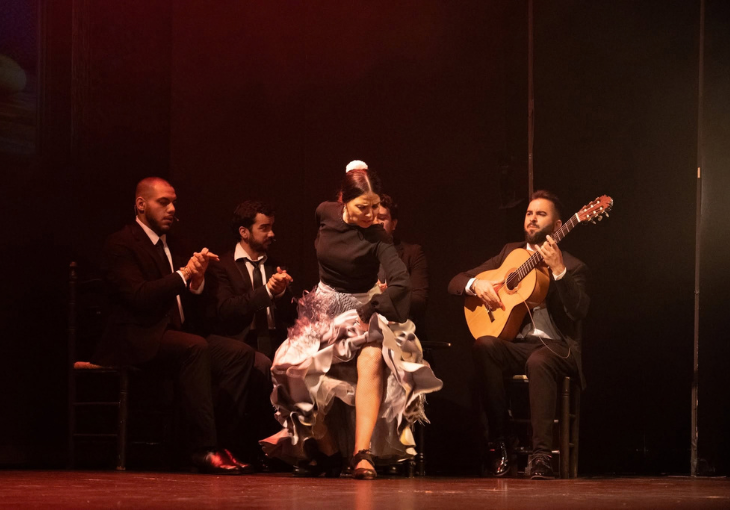
At Teatro Flamenco Madrid, our daily, live flamenco show, Emociones, brings together flamenco singing (cante), dance (baile) and guitar (toque) in a performance that combines tradition, technical mastery and artistic expression. Every encounter between the performers reveals new dimensions of an art form that comes to life on stage.
Is every live flamenco show improvised?
Not every element of a live flamenco show is improvised. Flamenco performances often follow a planned structure but the artists have the freedom to introduce spontaneous variations within established musical traditions.
Unlike some other performing arts, where every movement and musical intervention is predetermined, flamenco allows performers to adapt their interpretation as the performance unfolds.
A live flamenco performance may follow an agreed structure, including a selection of palos flamencos (traditional flamenco musical styles) and a planned sequence of performances. However, within this framework, there is room for creativity and variation.
A flamenco singer (cantaor or cantaora) might interpret a phrase differently, a guitarist may adapt their accompaniment and a dancer (bailaor or bailaora) can respond to what they hear through changes in movement and rhythm.
This does not mean that everything happens spontaneously. On the contrary, it is precisely the performers' preparation, technical ability and understanding of flamenco traditions that allow them to introduce variations while maintaining musical coherence.
How does each flamenco artist make a performance unique?
Every flamenco artist brings their own experience, influences and personal approach to their discipline.
Two flamenco singers may perform the same soleá, a traditional flamenco style known for its expressive depth, yet convey entirely different emotions. Similarly, two dancers interpreting alegrías may use different technical and expressive approaches to create their own distinctive performances.
Artistic individuality influences the intensity, tempo, pauses and interaction between performers.
These differences are equally apparent in flamenco guitar playing. Some guitarists favour restrained accompaniment, while others incorporate particular melodic or rhythmic techniques.
When different artistic personalities come together on a flamenco stage, their interaction creates a distinctive combination that shapes the performance.
This is why the experience depends not only on which flamenco styles are performed, but also on who performs them and how the artists communicate with one another.
Flamenco improvisation: creativity and tradition
Flamenco improvisation is one of the defining elements that makes each live performance different.
However, improvisation does not mean performing without preparation. Flamenco artists must master the compás (the rhythmic framework of flamenco), understand traditional musical structures and recognise the expressive possibilities of each palo flamenco.
For example, a dancer may extend a zapateado (rhythmic footwork sequence) in response to a musical phrase that inspires a new idea. The guitarist may adjust their playing to accompany this development, while the singer introduces subtle variations that change the emotional character of a passage.
These artistic decisions take place within a shared musical language.
In flamenco, improvisation is not simply individual creativity. It is a form of communication between performers, allowing each artist to contribute to a collective interpretation while respecting the traditions of the art form.
This balance between structure and spontaneity is one of the reasons why no two flamenco shows are exactly alike.
The connection between flamenco singing, dance and guitar
Another essential factor that makes every live flamenco show unique is the relationship between the artists on stage.
Flamenco singing, dance and guitar are not entirely separate disciplines. During a performance, they engage in a continuous musical dialogue that influences the rhythm, intensity and development of the show.
A dancer may use a llamada (a rhythmic signal) to announce a transition. A change in guitar accompaniment can alter the intensity of a passage, while a singer may extend a tercio (a sung phrase or section) before allowing the dance to take the lead.
The performers' ability to recognise and respond to these signals is fundamental to flamenco.
This communication becomes particularly important when the artists introduce spontaneous variations to the original structure.
For audiences watching a traditional flamenco performance in Madrid, observing this interaction offers an opportunity to appreciate the technical skill, concentration and artistic sensitivity involved in live flamenco.
How do different flamenco styles influence a live show?
Flamenco encompasses a wide variety of musical styles, known as palos flamencos, each with its own rhythmic, musical and expressive characteristics.
The selection of flamenco styles influences the atmosphere, pace and emotional character of a live performance.
For example:
- Seguiriyas are traditionally associated with solemnity, emotional intensity and profound expression.
- Alegrías have a brighter, more uplifting character and are closely associated with the flamenco traditions of Cádiz.
- Bulerías are known for their lively rhythmic possibilities, playful exchanges and opportunities for improvisation.
Combining different palos flamencos allows performers to create contrasts in mood, rhythm and expression throughout a show.
Furthermore, the same flamenco style can feel completely different depending on the artist interpreting it, the guitar accompaniment and the techniques used in the dance.
This variety is one of the reasons why attending a flamenco dance show in Madrid can offer a new experience on every visit.
Does the audience influence a live flamenco performance?
Yes, the audience can influence the atmosphere and energy of a live flamenco performance, although spectators do not directly determine its musical development.
The intimate setting of a tablao, a traditional venue dedicated to flamenco performances, allows artists to sense the reactions of the people watching.
Attentiveness, applause and emotional responses all contribute to the atmosphere of the performance.
Artists may perceive this energy and respond to it in different ways. However, audience reactions alone do not dictate the musical direction of the show. The performance primarily depends on the artists, their preparation and their interaction with one another.
What does change is the shared experience.
Every audience brings its own expectations, knowledge and emotions to the performance. As a result, the connection between the artists and spectators is different each time.
For visitors discovering live flamenco in Madrid, this sense of immediacy is an important part of experiencing flamenco in person rather than through a recording.
Is it worth seeing the same flamenco show more than once?
Yes, attending the same flamenco show more than once can reveal new musical details, artistic interpretations and interactions that may go unnoticed during a first visit.
Returning to the same flamenco venue allows you to focus on different aspects of the performance.
During your first visit, you may be captivated by the dancers' powerful footwork and expressive movements. On another occasion, you might pay closer attention to the subtleties of the singing, the guitar's falsetas (melodic passages) or the communication between the performers.
When the artists change, new combinations of styles, techniques and personalities also emerge.
Even when the repertoire remains the same, flamenco's expressive possibilities mean that each performance can reveal different nuances.
For those discovering flamenco for the first time, attending more than once can also help develop a deeper understanding of the different palos flamencos, their rhythmic structures and their cultural significance.
Whether you are a first-time visitor or a long-standing flamenco enthusiast, every performance offers something new to appreciate.
Experience live flamenco at Teatro Flamenco Madrid
Flamenco's richness lies both in its cultural traditions and in the ability of its artists to interpret those traditions through their own personalities and experiences.
The compás, improvisation, selection of flamenco styles and connection between performers all contribute to making every live flamenco show a distinctive experience.
At Teatro Flamenco Madrid, our daily, live flamenco show, Emociones, invites audiences to discover this diversity through the powerful relationship between flamenco singing, dance and guitar.
Whether you are experiencing flamenco for the first time or returning to enjoy another performance, each visit is an opportunity to discover new details and appreciate this traditional Spanish art form from a different perspective.
Explore our upcoming performances and book your flamenco tickets in Madrid to experience the artistry, emotion and spontaneity of live flamenco at Teatro Flamenco Madrid.