Filter content
How Do Flamenco Artists Communicate During a Live Performance?
Eye contact, musical cues and rhythm form a shared language that allows singers, dancers and guitarists to bring each live flamenco performance to life
When watching a live flamenco show, it can seem as though the singer, guitarist and dancer understand one another without ever needing to speak. A glance, a movement or a change in rhythm can be enough for everyone to know what is coming next.
Behind this connection lies a language that flamenco artists learn and develop throughout their careers. Flamenco rhythm (compás), musical cues known as llamadas, endings known as cierres, and the ability to listen and respond all allow singing, dancing and guitar playing to interact throughout each live flamenco performance.
At Teatro Flamenco Madrid, this communication is an essential part of what happens on our stage. Understanding how it works reveals many of the subtle details that make live flamenco such a special experience.
Flamenco rhythm: the language artists share
The first element that allows flamenco artists to communicate is compás, the rhythmic structure of flamenco.
Each flamenco style, or palo, has its own rhythmic characteristics that performers need to understand. Some, such as bulerías, follow twelve-beat cycles, while others, such as tangos, use four-beat patterns.
Understanding compás involves much more than simply keeping time. Artists must recognise rhythmic accents, understand where musical phrases begin and end and know how to introduce changes without losing coordination.
Flamenco handclapping (palmas) plays a fundamental role in this process. As well as providing accompaniment, it helps maintain the rhythmic framework around which the performance develops.
When all the performers share this understanding, they can introduce variations and respond to one another's musical ideas without interrupting the performance.
Flamenco dance cues (llamadas): how dancers signal changes
One of the most recognisable forms of communication during a flamenco performance is the use of dance cues known as llamadas.
These are sequences of movements and rhythmic footwork (zapateado) through which a flamenco dancer signals a musical intention to the other performers.
A llamada might announce the beginning of a new section, prepare a change in the accompaniment or indicate that a particular moment in the performance is approaching.
The guitarist and singer recognise these signals because they form part of flamenco's shared musical language.
However, llamadas are not identical in every performance. Each dancer may develop their own way of using them, making experience and familiarity between performers equally important.
This is why, during a live flamenco show, you will often notice artists watching their fellow performers closely, even when they are not taking centre stage.
The flamenco guitar: accompanying, listening and responding
The flamenco guitar plays a far greater role than simply providing musical accompaniment.
The guitarist needs to understand the structures of flamenco singing and dancing to adapt their playing to whatever is happening at each moment.
When accompanying a singer, the guitarist listens to the development of the melody, recognising pauses, endings and variations that may emerge during the performance.
When accompanying dance, the guitar responds to llamadas, supports the dancer's footwork and helps guide transitions between different sections.
The guitarist may also introduce falsetas, instrumental passages in which the guitar takes a more prominent role, creating opportunities to explore new musical ideas.
This relationship requires constant listening. Rather than simply following a predetermined sequence, the guitarist must be ready to respond to the musical ideas and decisions of the other performers.
Flamenco singing (cante) and its relationship with dance
Flamenco singing, known as cante, plays a central role in this communication.
The voice carries the melody and lyrics, but it also provides musical cues that the dancer must recognise and interpret through movement.
A flamenco singer (cantaor) might extend a phrase, introduce a melodic variation or change the intensity of a tercio, a phrase or section of flamenco singing. The dancer responds through movement, rhythmic marking steps (marcajes) or footwork.
In turn, the dancer may perform a llamada to signal when the singer should come in.
This exchange explains why accompanying flamenco dance requires specific knowledge and experience. Mastering a repertoire of songs is not enough: singers must also understand how the different sections of a performance are structured and how they relate to the dancer's movements.
Communication works both ways. The singing influences the dance, while the dance also shapes how the singing develops.
Eye contact and gestures: the communication audiences can see
Not all flamenco signals are musical.
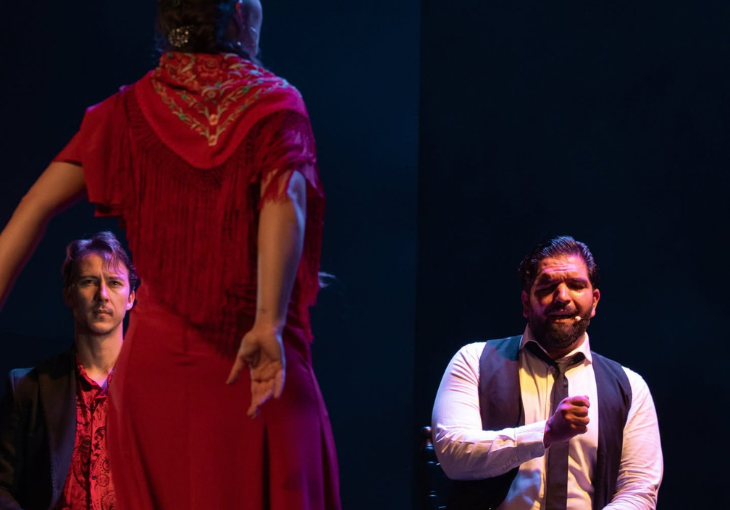
During a performance, eye contact and gestures also allow artists to communicate. Sometimes, a subtle signal is all that is needed to confirm an entrance, prepare an ending or respond to an unexpected change.
These signals become particularly important when performers have not worked together for long or when a musical idea develops differently from what was originally planned.
The physical proximity of the artists makes this exchange easier.
For the audience, noticing these small interactions reveals another dimension of flamenco that can easily go unnoticed when all attention is focused on the dancing or singing.
A glance between the guitarist and singer, for example, might anticipate a musical change that becomes apparent to the entire audience just a few seconds later.
What role does improvisation play in a flamenco performance?
Flamenco improvisation is one of the reasons why communication between performers is so important.
Although a performance may follow a previously agreed structure, there is still room for artists to introduce variations depending on how the music develops.
A dancer might extend a footwork sequence, a singer might interpret a tercio differently and a guitarist might adjust their accompaniment in response to these decisions.
Improvisation does not mean performing without any structure or reference points. Quite the opposite: it requires a deep understanding of flamenco styles, compás and the musical conventions that performers share.
The stronger this knowledge, the more freedom artists have to introduce changes while maintaining the coherence of the performance.
Improvisation also depends on listening. Every musical idea calls for a response and it is precisely this ability to react that allows a flamenco performance to take shape collectively on stage.
Discover this shared language at Teatro Flamenco Madrid
The next time you enjoy a live flamenco show, try paying attention to the smaller details: how the guitarist watches the dancer before a llamada, how the handclapping maintains the compás, or how the singing and dancing respond to the same musical phrase.
Behind each of these moments lies a shared language combining technique, experience and a deep understanding of flamenco tradition.
At Teatro Flamenco Madrid, our artists bring each performance to life through this relationship between flamenco singing, dancing and guitar playing, giving every show its own distinctive character.
We invite you to discover this communication up close and appreciate all the details that make flamenco such a vibrant, living art form. Explore our programme and book your flamenco tickets to experience authentic live flamenco in Madrid.